Smart bulbs are cheaper. Here is when that stops being true.
Neeraj Gupta · Updated 3 September 2026
Smart bulbs suit table lamps and rooms with a single fitting. Smart switches suit any room where somebody might turn the light off at the wall. In most Indian family homes, that is most rooms.
The choice looks like a budget question. A smart bulb costs a few hundred rupees and a switch install costs thousands. But the two products fail in completely different ways, and the failure is what decides it.
The problem with smart bulbs, in one sentence
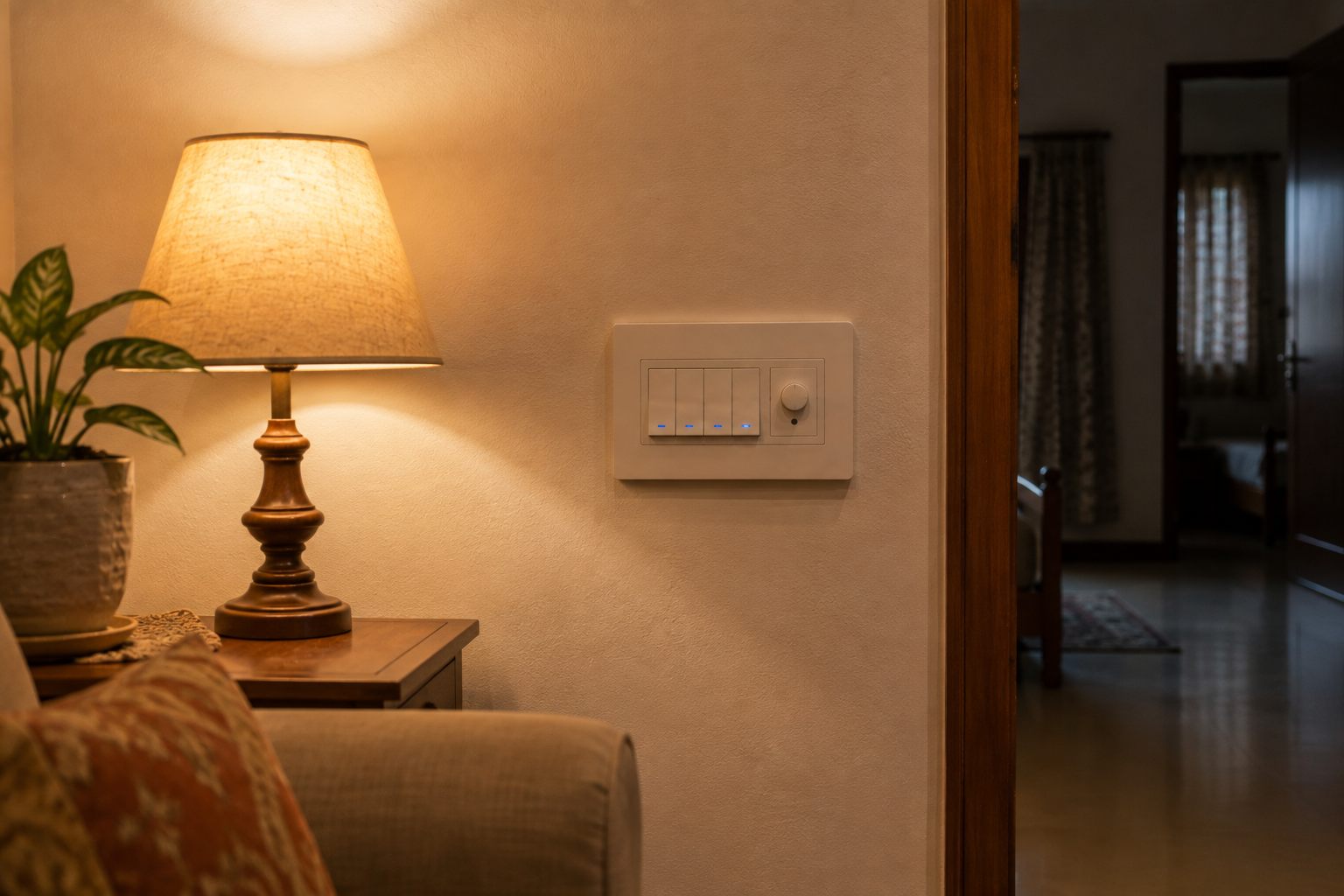
A smart bulb needs power all the time to listen for instructions. Your wall switch cuts that power. So the moment anyone flicks the switch off, the bulb is a normal bulb again. It stops answering the app, it stops answering voice, and it ignores every schedule you set.
Fitting smart switches instead removes the problem rather than managing it. You can put a sticker on the switch asking people not to touch it. We have seen plenty of homes that have done exactly that. It works until a guest visits, or a cleaner comes, or a child reaches the switch.
The comparison, plainly
| Smart bulbs | Smart switches | |
|---|---|---|
| Cost to start | Very low | ₹7,000 – ₹13,000 per room |
| Wall switch still works | No. It kills the bulb | Yes, always |
| Works for guests | Only if nobody touches the switch | Yes |
| Controls fans | No | Yes |
| Needs a neutral wire | No | Usually, with workarounds |
| You take it when you move | Yes, easily | Yes, in an afternoon |
Why this hits Indian homes harder
Two things make the bulb problem worse here than in the marketing photos.
First, most Indian rooms have one wall switch per light, sitting at the door where everybody passes. It is the most touched object in the room. In a house built around a single lamp on a side table, a smart bulb is fine. In a house where six people walk past a switchboard all day, it is not.
That gap widens the moment somebody in the house will not use an app at all. A bulb that has been switched off at the wall cannot be turned back on by anything, which is why we would not fit one in a parent's house.
Second, we automate fans, not just lights, which is one of the systems on everything we install. A smart bulb cannot control a ceiling fan. In a Jaipur summer that is not a small gap.
When we would tell you to buy a bulb instead
There are real cases where a bulb is the right answer and hiring us would be a waste of your money.
Buy bulbs if you want colour changing light in one corner of a room. Buy bulbs for a table lamp that has its own switch on the cable. Buy bulbs if you are renting for a few months and want something you can pack in a bag. And buy bulbs if you simply want to try the idea before spending anything serious.
What we would not do is wire a whole house with smart bulbs to avoid an install. It costs more than people expect once you count every fitting, and it leaves you with a house that breaks whenever somebody uses a switch normally.
The middle option most people miss
You do not have to pick one for the whole house. Fit smart switches in the rooms that matter, which is usually the living room and the main bedroom, and use bulbs for the odd lamp. That is what a lot of our customers end up with, and it is a sensible place to land.
If you want to know what the switch route would cost in your home, the published bands are all on the site. The estimator will give you a range in about a minute.
One thing to check before you decide
If you lean towards switches, there is a single fact about your house that changes both what is possible and what it costs: whether your switchboard has a neutral wire. About one in four of the Jaipur boards we open does not have one.
It takes five minutes to check yourself, and it costs nothing. How to check your own board
Questions people ask before choosing
Can I mix smart switches and smart bulbs in one house?
Yes, and most people end up doing exactly that. Switches go in the rooms where somebody will reach for the wall, which is usually the living room, the bedrooms and the passage. Bulbs go in the table lamps and the one corner where you want colour. Nothing about the two conflicts.
Do smart bulbs work with ceiling fans?
No. A smart bulb is a light, so a fan needs a switch or a regulator module behind the plate. In a Jaipur summer that is not a small gap, because the fan is the thing you most want to turn on before you get home.
What happens to smart bulbs when the power cuts?
They come back on when power returns, usually at whatever setting they had before. That is fine for a lamp and irritating in a bedroom at two in the morning. A switch behaves the way the old switch did, which is what most households actually want.
Are smart bulbs cheaper over a whole house?
Not usually, once you count every fitting. A house has more bulbs in it than switchboards, and each bulb is a separate purchase that fails on its own schedule. The comparison only favours bulbs when you are lighting one or two rooms.
Do I need an electrician to fit smart bulbs?
No, and that is their real advantage. You screw them in. If you are renting for a few months, or you want to try the idea before spending anything serious, that matters more than anything else on this page.
Most people are not
ready to book a survey.
That is completely reasonable for a purchase this size. So here are three smaller steps that still get you a real answer, and one that gets you a price.
Send me the price list
One message on WhatsApp, and you get the band sheet back. Every package and add-on, with its working range. No call, no form.
Message on WhatsApp Two minutesSend a photo of your switchboard
Open the plate, photograph the wiring, send it. We will tell you whether you have a neutral wire. That single fact moves your price more than anything else.
Send a photo Ten minutesTalk it through on a call
Ring us and describe the house. We will tell you honestly whether what you want is a ₹40,000 job or a ₹6,00,000 one before anybody drives anywhere.
+91 92143 14348 The real answerBook the free survey
We come to your home, open a board, measure the windows, and give you a room-by-room design with a real number. Free, and you owe us nothing afterwards.
Book a survey