
What actually fails in a smart home, and when.
Neeraj Gupta · Published 24 August 2026
Everybody selling home automation will tell you their hardware is reliable. Almost nobody will tell you what comes back, how old it was, and what it cost to put right. Almost nobody sees the failures. The panel goes back to the manufacturer and the installer never learns anything from it.
We repair panels ourselves, in Jaipur, on our own bench, and we diagnose everything else in the house rather than sending it away unopened. That means we see our customers' faults first-hand, and we can tell you what we see rather than what a datasheet claims.
This page is not a warranty statement or a sales argument. It is what running that bench looks like, including the parts that are inconvenient for us.
The short version
Smart home hardware does not mostly fail the way people fear it will. The common worry is that the electronics stop working after the warranty expires. What we actually see is that most returns cluster in a small number of specific, boring, predictable places. The components people worry about least are often the ones that go first.
The headline number
About five percent of what we have installed has come back to us with a fault. Nineteen units in twenty are still doing what they were fitted to do and have never needed us again. That is across twenty-nine homes. It is a small enough sample that we will say so rather than dress it up. It is what we have, and it is more than anybody else in this category publishes, which is nothing.
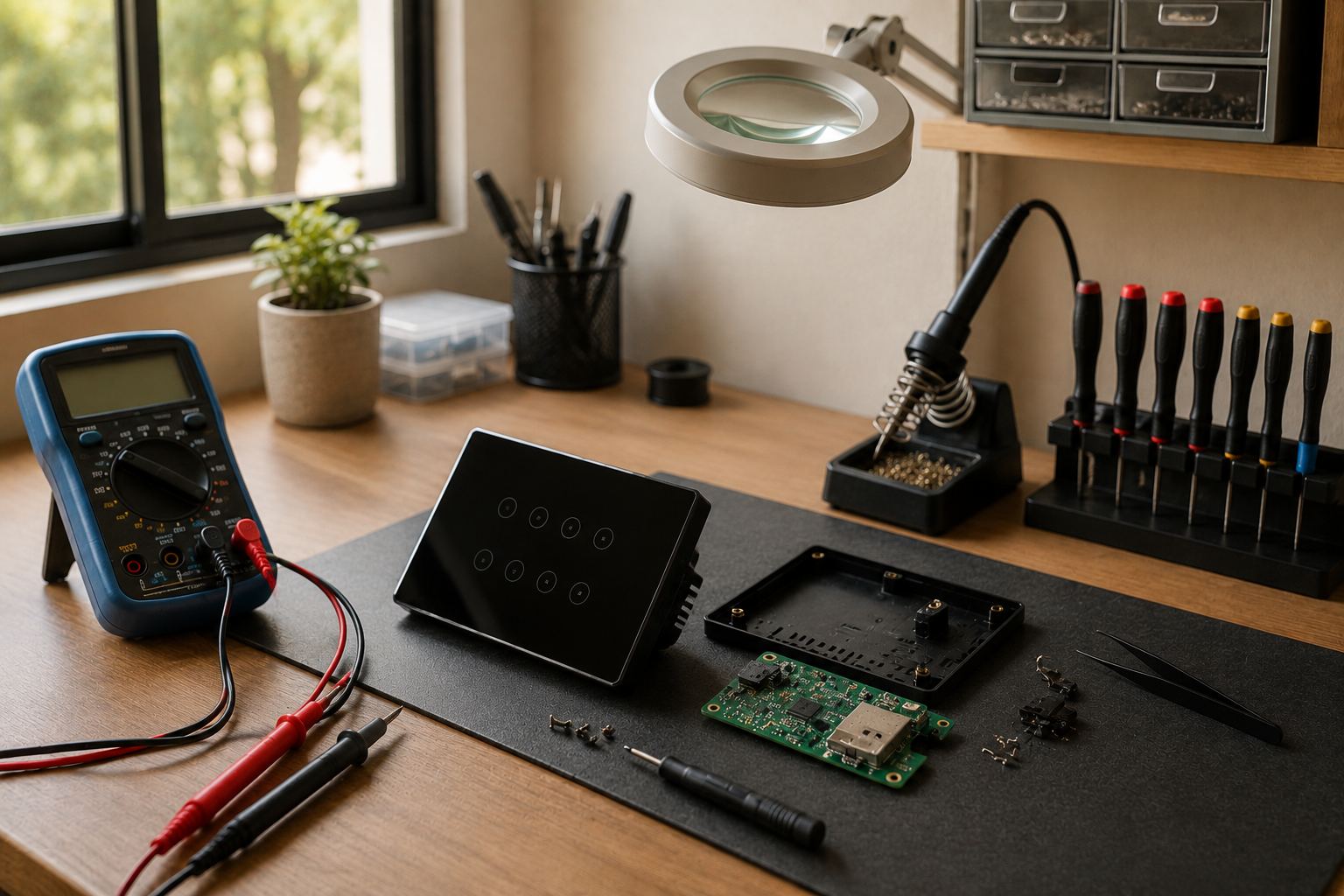
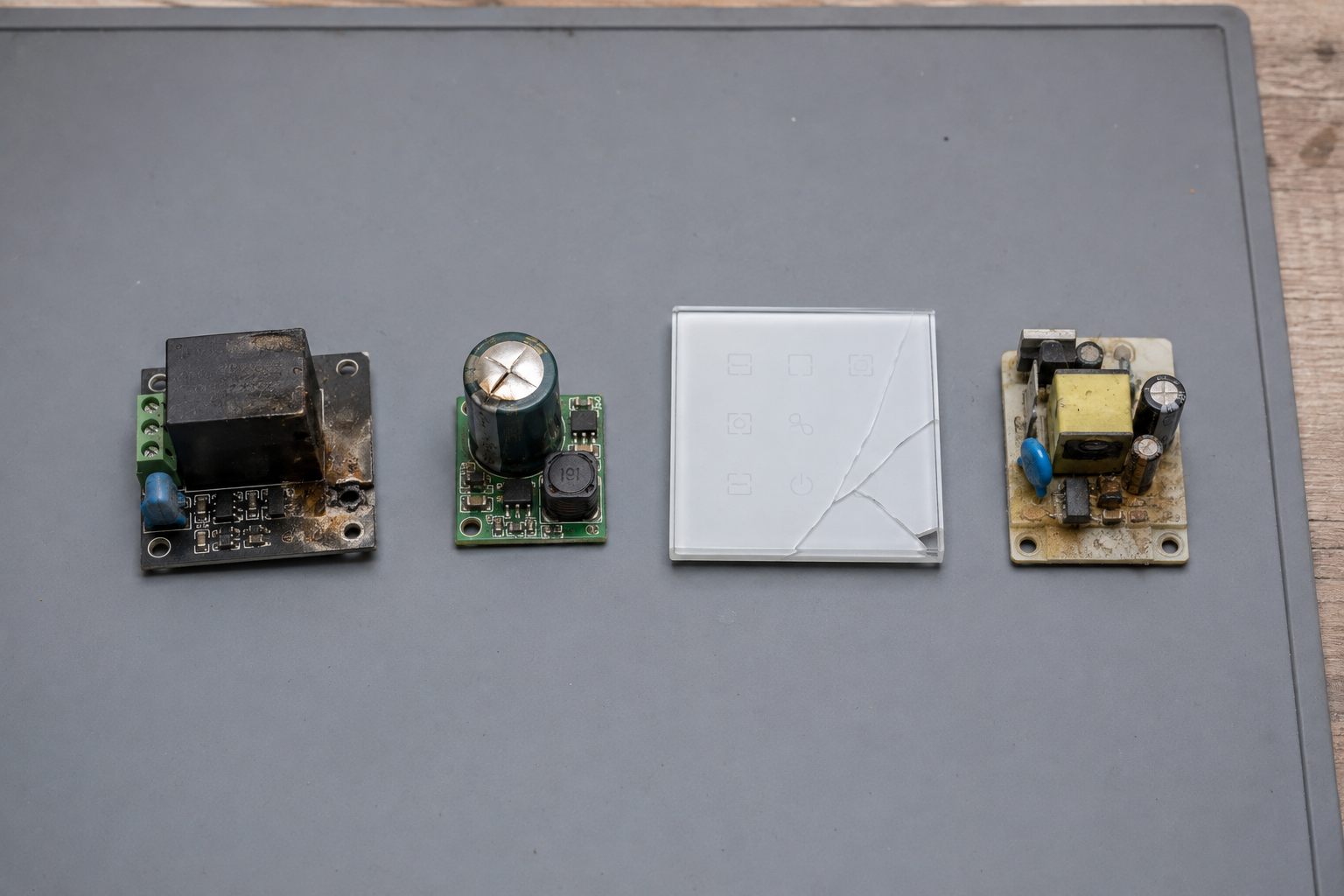
The more useful finding is what is wrong with the one in twenty. In most of the panels that reach the bench, the failure is in the power supply. Not the touch layer. Not the glass. Not the firmware, not the Wi-Fi, not the app, and not any of the things people actually worry about when they hesitate over a touch panel.
That is worth sitting with, because it inverts the usual fear. The anxiety about smart switches is that the clever part will stop being clever. That the software will rot, or the brand will abandon it, or the touch surface will stop reading a finger. What we see instead is the least clever component in the box giving out: the bit that turns mains into the low voltage everything else runs on. It has been made much the same way for forty years, it is one of the cheapest things inside the panel, and it is replaceable.
Which is the whole argument for a local bench. The dominant failure on the most expensive component we fit is a cheap part, and it can be changed in an afternoon. That only happens if somebody is willing to open the panel rather than courier it back and quote you for a new one.
Failures by component
The sections below are the categories worth covering. Each needs the same four things: what goes wrong, roughly how often, at roughly what age, and what it costs to fix.
Five columns. Swipe the table sideways to reach typical age, whether it is repairable, and the repair-versus-replace call.
| Component | Dominant fault | Typical age | Repairable | Repair vs replace |
|---|---|---|---|---|
| Touch panels | Power supply | Yes, by part replacement | ||
| Retrofit modules | ||||
| Curtain motors | ||||
| Tank controllers & sensors | ||||
| Sensors (motion, door) | ||||
| Hubs & gateways |
Touch panels
The most visible component and the one customers ask about most, because a dead panel is a dead board on a wall in the middle of the house.
The dominant fault is the power supply, as above. What that means in practice is that a dead panel is usually not a dead panel. It is a working panel with a dead feed, and the repair is a part change rather than a rebuild. We do not refurbish panels and we do not replace touch glass; we replace the component that failed and send it back to the wall it came off.
Retrofit modules behind the plate
Hidden in the back box behind the plate, so a failure here presents as one circuit that stops responding while everything else carries on. These are the modules used in every smart switch install.
Curtain motors
Mechanical rather than electronic, which makes motorised curtain tracks a different kind of risk. Wear rather than sudden death.
Water tank controllers and sensors
Sitting on a Jaipur terrace, exposed to 45°C summers, monsoon, and dust, doing the least glamorous job in the house. Why the tank job matters here is set out in how Jaipur supply behaves.
Locks, cameras and door phones
The category where a failure has the highest consequence, because it can leave somebody outside their own house. It is also why we publish what it costs to replace a part rather than quoting on the day.
The failures that are not hardware
A meaningful share of what gets reported as a fault is not a broken component at all. A router gets replaced and the Wi-Fi password changes. A brand pushes a firmware update that changes how something behaves. Somebody removes an app while clearing space on a phone. A cloud account gets closed.
These matter because they are the failures a standards-based system survives and a proprietary one often does not. That is the practical argument for leading with Matter and Zigbee rather than a brand's own ecosystem.
What we would not buy
The section that makes this page worth reading, and the one that is uncomfortable to write.
What this means before you buy
Three things follow from all of the above, and they are the reason we design the way we do.
Every wall switch keeps working. A component failure should cost you the smart behaviour, not the light. This is why we will not sell a house where one tablet on one wall is the only way to turn something on.
Standards first, proprietary named as proprietary. Matter and Zigbee wherever a good product exists at a sane price, so a dead brand costs you one device rather than the house. Where we specify something proprietary, it says so on your design sheet along with what happens if that company disappears.
Repairable locally beats replaceable remotely. A component we can fix on a bench in Jaipur in days is worth more to you than a marginally cheaper one. The cheaper one has to be couriered to another state. How the service bench works
Most people are not
ready to book a survey.
That is completely reasonable for a purchase this size. So here are three smaller steps that still get you a real answer, and one that gets you a price.

Send me the price list
One message on WhatsApp, and you get the band sheet back. Every package and add-on, with its working range. No call, no form.
Message on WhatsApp Two minutesSend a photo of your switchboard
Open the plate, photograph the wiring, send it. We will tell you whether you have a neutral wire. That single fact moves your price more than anything else.
Send a photo Ten minutesTalk it through on a call
Ring us and describe the house. We will tell you honestly whether what you want is a ₹40,000 job or a ₹6,00,000 one before anybody drives anywhere.
+91 92143 14348 The real answerBook the free survey
We come to your home, open a board, measure the windows, and give you a room-by-room design with a real number. Free, and you owe us nothing afterwards.
Book a survey