
Jaipur water arrives when it arrives. Your tank should not need you to be home.
Neeraj Gupta · Published 24 August 2026
In a city with continuous mains pressure, tank automation is a convenience. In Jaipur it is closer to essential, because the supply window is not yours to choose. Every problem it solves comes down to the same thing: a person has to be paying attention at a time nobody decided.
This guide covers what actually goes wrong with a manual setup, and what a controller does about each one. It also covers how to size a tank against your own supply window, and the one failure that costs real money.

The three things that go wrong, and what each costs
1. Nobody was home when the water came
The most common one, and the most annoying. Supply arrives in a window you do not control, the pump is not running, and by the time somebody is home to switch it on the supply has gone. You then spend a day or two on whatever was already in the tank.
What a controller does: it watches the line rather than the clock. When water is available and the tank is low, it runs. That might be three in the afternoon or three in the morning, with nobody awake for it.
2. Somebody forgot the motor was running
The tank fills, keeps filling, and overflows down the outside wall for an hour. It wastes water in a city that does not have much to spare. It wets the street, and over time it does no favours to the wall it runs down.
What a controller does: a level sensor near the top cuts the motor when the tank is full, whether or not anybody remembered.
3. The pump ran dry
This is the expensive one. A pump running with nothing to draw has no water passing through it to carry heat away, and it overheats. Depending on how long it runs and what kind of pump it is, that means anything from a seized impeller to a burnt-out motor winding.
It happens most easily in exactly the scenario the other two problems create: somebody switches the motor on hopefully, gets distracted, and the supply was not actually there.
What a controller does: dry-run protection cuts the pump when there is nothing to draw. This is the single strongest reason to fit a controller even if you never open the app, because the part it protects costs several times what the controller does. Controllers themselves are not immune, and what fails and when is where we publish what comes back to us.
Sizing a tank against your own supply window
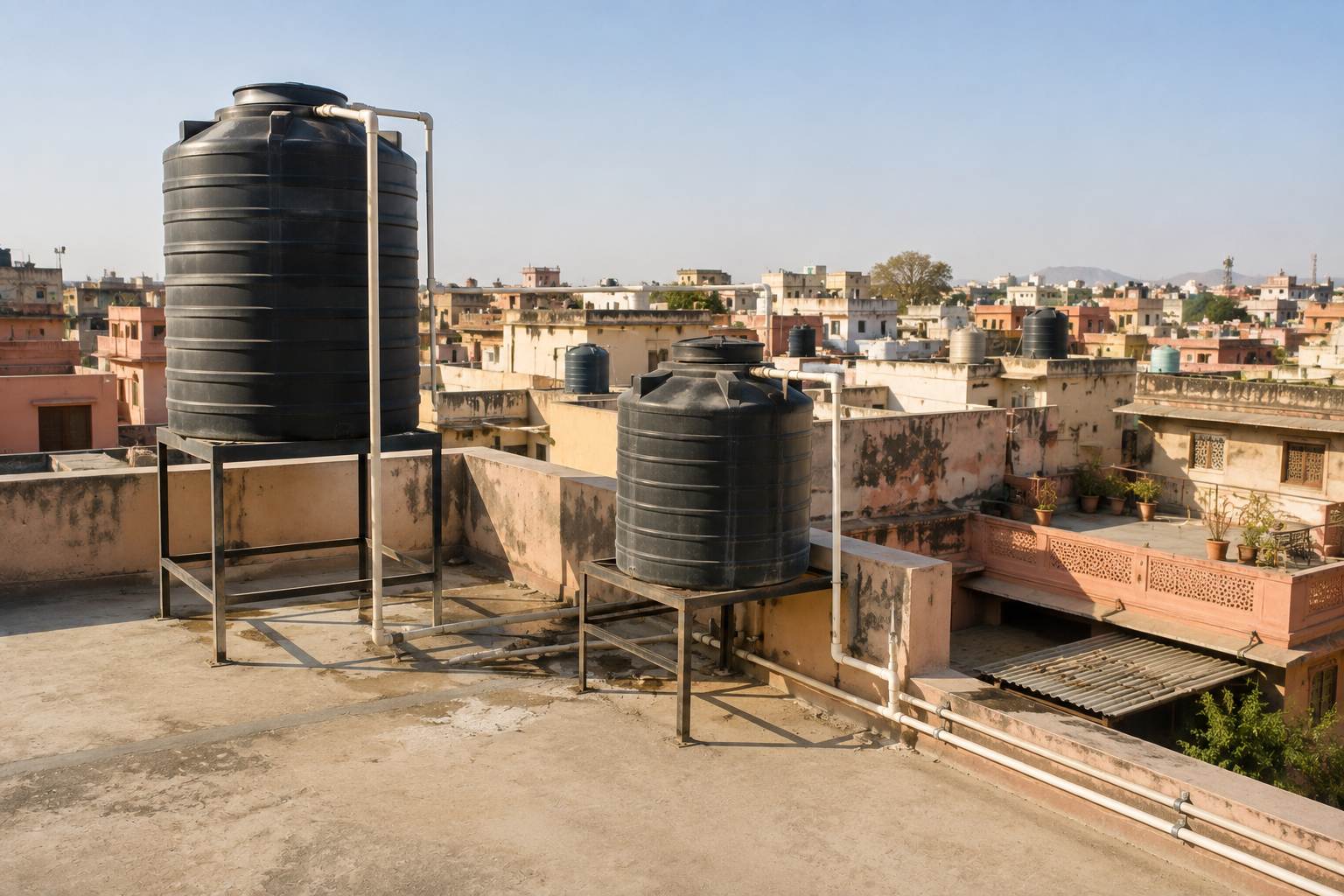
The useful question is not "how big should a tank be" in the abstract. It is how long your household has to last between fills. That depends on two things you can find out this week: how often supply reaches your area, and roughly how much you use in a day.
Once you know both, the tank either bridges the gap comfortably or it does not, and no amount of automation changes the arithmetic. Automation makes sure you capture every supply window; it cannot create water that never arrived.
This is worth saying plainly because it is the honest limit of what we sell. If your tank is genuinely undersized for your supply pattern, a controller will make that situation better but it will not make it fine.
Sump to overhead, and why it is a different job
Many Jaipur homes do not fill the overhead tank from the mains directly. Supply goes into an underground sump, and a second pump lifts it to the tank on the roof. That is two water levels, two failure modes and, if you want it fully automatic, two sensors.
It is a common enough arrangement that it is worth knowing which one you have before you ask anybody for a price, including us. The band it falls into sits with every published price on the site.
We do automate it, and we treat it as the normal case in Jaipur rather than an extra. The condition is the same one that applies to any tank job we take on: cable has to already run from both tanks back down to the motor. A sensor with no way to reach the controller is not a job we can do without chasing walls, and chasing walls is the thing retrofit exists to avoid. What tank automation includes, and what it needs from you
Common questions
Does this work if the internet is down?
Yes. Every rule that matters runs on the controller at the tank, not in a cloud account. Start on low, stop on full, cut on dry. A broadband outage costs you the notification on your phone and nothing else, which is the same principle behind everything else that keeps working when the connection drops.
Do I need to replace my pump?
No. The controller sits between your supply and the starter you already have, so the pump, pipework and tank all stay as they are. We check the starter is safe and properly earthed before building on top of it, and if it is not, we will say so rather than wire around it.
Can I still run the motor by hand?
Always. The manual override stays in place on every job, for the same reason every smart switch in the house still works by hand. If the automation is the only way to do something, we have installed it wrong.
Most people are not
ready to book a survey.
That is completely reasonable for a purchase this size. So here are three smaller steps that still get you a real answer, and one that gets you a price.
Send me the price list
One message on WhatsApp, and you get the band sheet back. Every package and add-on, with its working range. No call, no form.
Message on WhatsApp Two minutesSend a photo of your switchboard
Open the plate, photograph the wiring, send it. We will tell you whether you have a neutral wire. That single fact moves your price more than anything else.
Send a photo Ten minutesTalk it through on a call
Ring us and describe the house. We will tell you honestly whether what you want is a ₹40,000 job or a ₹6,00,000 one before anybody drives anywhere.
+91 92143 14348 The real answerBook the free survey
We come to your home, open a board, measure the windows, and give you a room-by-room design with a real number. Free, and you owe us nothing afterwards.
Book a survey